Why I built an alert that fires only twice a year
Sensifty's watch alert arms when a stock becomes stretched and fires once, when the stretch cools or the price reaches its first reference level. For a typical stock that is two or three times a year, about five weeks after the stretch began.
I used to set price alerts the way most people do. A number below the current price, a notification when it gets there. Within a month I had dozens, and they fired at the wrong moments: on a dull day of drift, or in the middle of a fall that had much further to go. I started ignoring them, and then I deleted them.
Then, started my experimentation with truth, albeit on a smaller scale. I intended to build a customized alert finder, that suited my intentions...and it was a simple, single rule - dont be annoying.!
When I built Sensifty, I wanted an alert I would actually read. That meant it had to be rare, and it had to mean something.
How the watch alert works
It has two steps. First it waits for the stock to become stretched: its score reaches 70, meaning the price is high against the stock's own last five years. Nothing happens yet. Then it fires once, when either the price comes back to the first reference level (L1) or the score cools below 40. After that it stays quiet until the stock is stretched again.
Across 49 large NSE stocks over sixteen years, that worked out to a median of about 2.7 alerts per stock per year. A watchlist of 20 stocks sees roughly one a week, never fifty.
How often it comes, and where
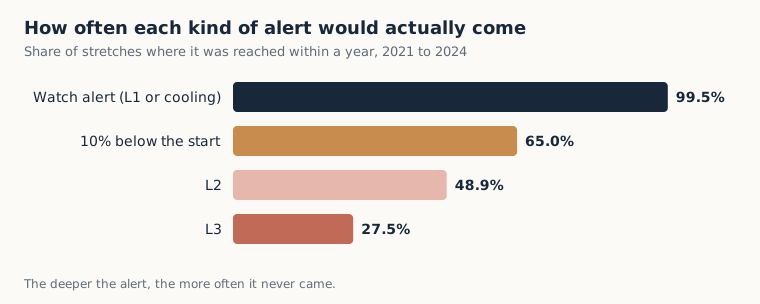
For the 3,808 stretches I tested among the 500 most traded NSE stocks, the watch alert came within a year in 99.5% of cases. That is by design: a stretch almost always cools eventually.
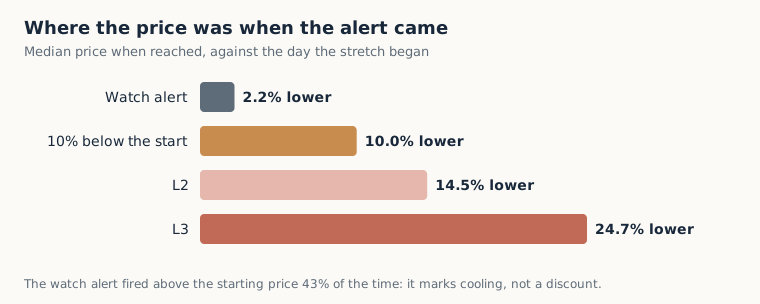
What surprised me was the price. When the watch alert fired, the price was a median of only about 2% below where the stretch began, and in 43% of cases it was higher. So the alert is not a discount signal. It marks the moment the run-up has settled, which is when I find it easiest to look at a stock calmly.
The deeper alerts behave differently. Pro can also alert at L2 and L3. They come at lower prices, about 15% and 25% below the start, but much less often: L2 in about half of stretches, L3 in about a quarter.
How long it takes
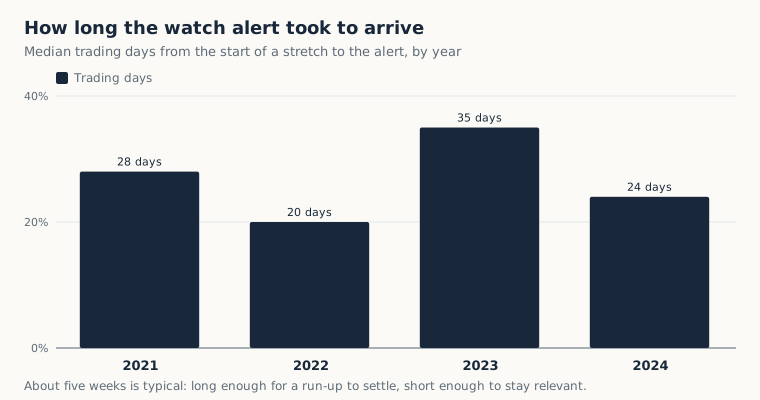
The typical wait was 26 trading days, a little over five weeks. Long enough for the excitement to fade, short enough that the stock is still on your mind.
What it is for
The alert is not telling you to buy. It is telling you that a stock you chose to watch has gone from stretched to calmer, once, so you can take a fresh look when you are not caught up in the run. Whether to do anything is your decision, made with whatever you know about the business.
Written by the person who builds Sensifty.
Sensifty is a Chrome extension for people who invest in NSE and BSE stocks. It shows how stretched a stock is against its own last five years, reference levels from its past, and sends one quiet alert when a stretched stock cools off. End-of-day data; technical information only, not investment advice. What it is · Track record